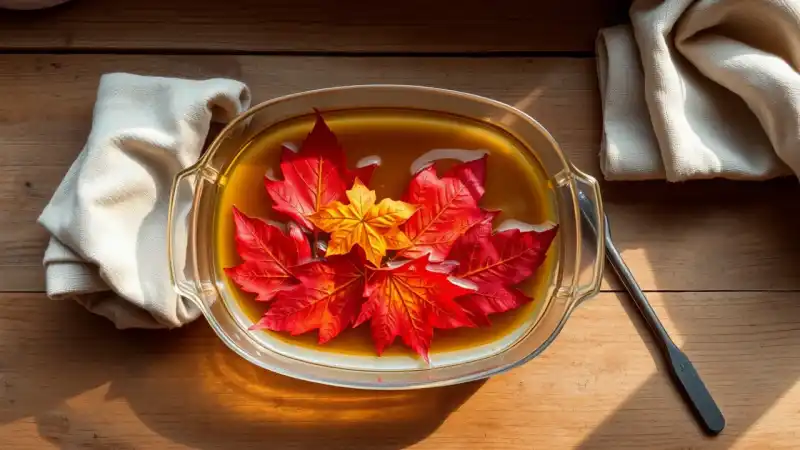
The Weekend Project: Glycerin-Preserved Fall Leaves
Pressed leaves usually go brittle, but a glycerin bath leaves them soft. The glycerin takes the place of the water inside each leaf, so the leaf does not dry out and turn fragile. It takes about 20 minutes to set up on a Saturday. After that, the leaves only need time in the bath.
What You Need for Glycerin-Preserved Leaves
- Vegetable glycerin, about 1 cup for a small batch
- Hot water, about 2 cups
- A flat, shallow container big enough to keep the leaves fully underwater
- A plate or other weight, plus a lid or tray to cover the dish
- Fresh leaves, loose or on small branches
- Paper towels
Use one part glycerin to two parts water. One cup of glycerin to two cups of water is enough for a small batch. Pick leaves that still bend easily. Leaves that have been lying on the ground for days, drying out, will not work as well.
Step by Step
- Mix the solution. Stir the glycerin into hot water. Glycerin is thick, and hot water helps it dissolve and blend. Be careful with hot water, and keep children away from this step.
- Submerge the leaves. Pour the solution into the dish and lay the leaves in it. Any part of a leaf that sticks out above the liquid will not be preserved.
- Weigh them down and cover. Put a tray or plate on top and set a couple of water-filled bowls on it so the leaves stay under. A lid or upside-down baking dish keeps insects out of the solution.
- Wait three to five days. Thin leaves can be ready sooner. Thicker leaves may need a little longer to take up the glycerin. A leaf is done when it feels soft and pliable, with a slightly waxy surface.
- Blot and dry. Take the leaves out, shake off the extra liquid and lay them between paper towels for one to two days.
How Long the Project Takes
Expect about 20 minutes of work on day one, three to five days of soaking, then a day or two of drying. If you start on Saturday, the leaves should be ready by the following weekend.
The color does change over time. Preserved leaves usually last from many months up to a year, slowly turning browner, while deep red leaves keep their color the longest.
Adapting It: Whole Branches in a Jar
To preserve a branch with its leaves attached, you stand it in the solution instead of soaking it. Cut each branch 4 to 6 inches or more beyond the finished length you want. Then open up the stem ends so they can soak up the solution. Use a knife to split the bottom 1 to 2 inches of thin stems, or crush the bottom 3 to 4 inches of thick, woody branches with a hammer.
Stand the stems upright in a narrow-mouthed container with enough solution to cover the split or crushed ends. Keep the jar out of direct sunlight and add more solution as the level drops. Depending on the plant, this can take 2 to 6 weeks. Take the stems out once the solution has reached all the way to the tips of the leaf veins.
This also works on holiday greenery. Magnolia and eucalyptus keep some of their color and flexibility when preserved with glycerin, and so do boxwood and cedar. Magnolia is finished when its leaves turn golden brown.
Ways to Use the Leaves
Because the leaves stay flexible, you can wire them into wreaths, string them into a mantel garland or scatter them down a Thanksgiving table. Branches can go into a vase as a centerpiece that lasts well past the season.
FAQ
– Why do some leaves come out patchy?
Patches usually mean the glycerin hasn’t reached every part of the leaf. Leave them in longer, and make sure woody stems were freshly cut and split. With loose leaves, check that nothing was floating above the liquid.
– Can I preserve flowers this way?
Some flowers, yes. The method is mostly used on foliage, but baby’s breath and the flower heads of grasses can be preserved with glycerin too.
Sources
- How I Preserve Fall Leaves with Glycerin – Cottage On Bunker Hill — cottageonbunkerhill.com
- How to Preserve Leaves: 5 Easy Methods for Fall — plantshed.com
- How To Preserve Leaves In Glycerin – Garden Guides — gardenguides.com