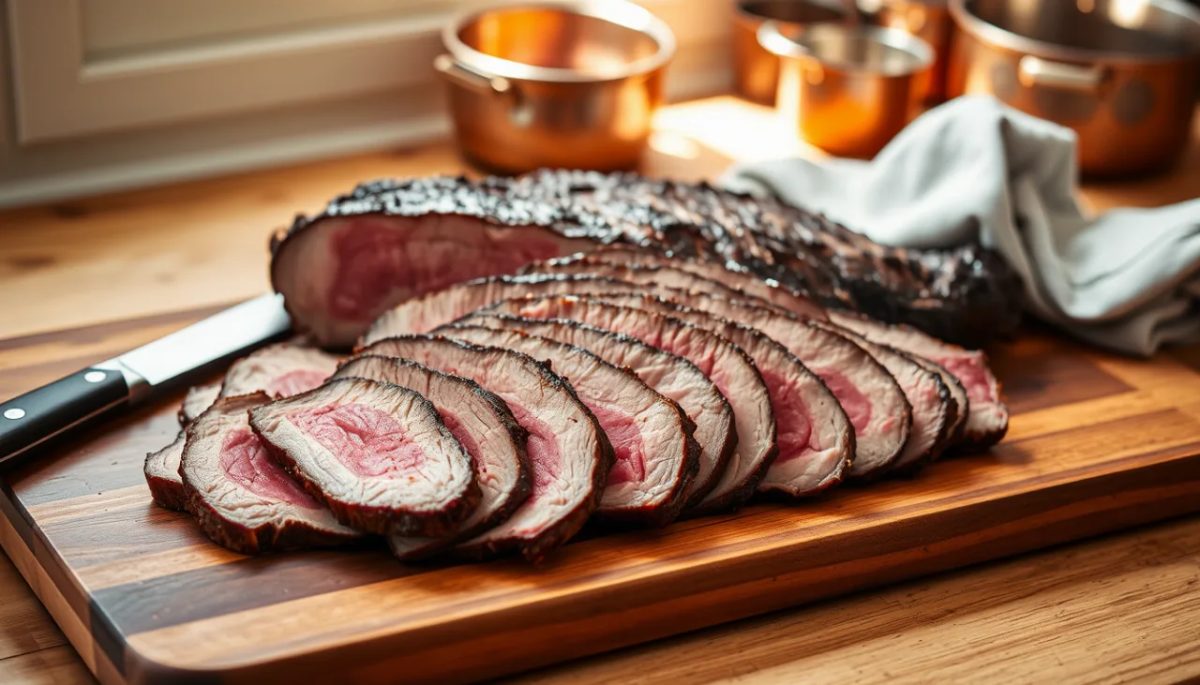
How to Cut a Tri-Tip: Slice It Against the Grain
To cut a tri-tip, rest the cooked roast 10 minutes, find the spot near the center where its two grain directions meet, and slice the roast in two there. Then cut each half across its own grain into slices about ¼ inch (6 mm) thick. The grain shifts, so each half needs its own angle.
What you need
- A long, sharp slicing knife (10 to 12 inches) or a sharp chef’s knife
- A cutting board with a juice groove
- Optional: toothpicks to mark the grain, and tongs or a carving fork
How do you cut a tri-tip step by step?
Tri-tip is a triangular roast from the bottom sirloin, and it contains two muscles whose fibers run in different directions. Cutting it in four steps handles both.
- Rest the meat. Let it sit 5 to 10 minutes, tented loosely with foil, so juices settle instead of running onto the board. The USDA’s safe minimum for whole cuts of beef is 145°F (63°C) plus a 3-minute rest; many cooks pull tri-tip at 130 to 135°F (54 to 57°C) for medium-rare, and the temperature climbs a few degrees while it rests. Choose your doneness, and know that the USDA figure is the official safe minimum.
- Find the grain. Look for the thin lines of muscle fiber. On the thick, rounded end they run one way. On the thinner tail they fan out and turn, often forming a V.
- Split the roast. Cut straight down where the two patterns meet. You get a larger, thicker piece and a smaller, thinner one.
- Slice each piece across its grain. Turn each half so the knife crosses the fibers at a right angle. Use long, smooth strokes and slices about ¼ inch thick.
Why cut tri-tip against the grain?
Cutting against the grain shortens the muscle fibers in each bite, so the meat is tender rather than stringy. Tri-tip is lean and fairly coarse, so slicing with the grain leaves long, chewy strands even when the roast is cooked perfectly.
How do you tell which way the grain runs?
The grain runs in the direction of the thin parallel lines on the surface of the meat. Cooked tri-tip with a crust can hide them, so check the cut side or trim a small corner to see the fibers.
- Push a toothpick into the meat parallel to the lines, then cut perpendicular to it. Remove every toothpick before serving.
- Mark the grain before cooking if the rub or char will hide it. Many cooks note the split point on the raw roast, where the fat cap and the boomerang curve are.
- Slice a test piece. If it pulls apart in strings, rotate the roast and try again.
Common mistakes and quick fixes
| Mistake | Result | Fix |
|---|---|---|
| Slicing right out of the oven | Juices pool on the board | Rest 5 to 10 minutes |
| One direction for the whole roast | Half the slices are chewy | Split at the grain change first |
| Slices over ½ inch (13 mm) | Tougher bites | Aim for about ¼ inch (6 mm) |
| Dull knife | Torn, ragged slices | Sharpen or hone first |
Can you slice tri-tip into steaks, strips or cubes?
Yes. Raw tri-tip can be cut into steaks about 1 inch (2.5 cm) thick, cut across the grain, for quick grilling or pan searing. Cooked leftovers can be sliced thin for sandwiches or cubed for tacos and salads, again cutting across the grain.
Store leftovers in the refrigerator within 2 hours of cooking and eat them within 3 to 4 days. Reheat gently to 165°F (74°C), or eat cold, so thin slices don’t dry out.
FAQ
– What knife should I use to cut a tri-tip?
A sharp 10 to 12 inch slicing knife is ideal because it cuts in one long stroke. A sharp chef’s knife works fine, and a serrated knife tends to shred the crust.
– Should I trim the fat before slicing?
Trim only thick, rubbery pieces of fat or silver skin, and do it before or after slicing as you prefer. Thin rendered fat adds flavor, so there is no need to remove all of it.
– Which end of a tri-tip is more tender?
Both are tender when sliced correctly. The thinner tail end cooks to a higher doneness sooner, so it is often more well-done, which suits guests who prefer less pink.