How to Hem Jeans by Hand: Keep the Original Hem or Sew a New One
Hemming jeans by hand takes four moves. Mark the new length while wearing your usual shoes, fold the extra fabric up, pin it, then sew around the leg with a backstitch using heavy-duty or doubled matching thread. First decide whether to keep the factory hem by folding it up, or cut the leg and sew a new double-fold hem.
You don’t need a sewing machine. A sturdy needle, strong thread and patience at the thick side seams will give you a hem that holds up in the wash and looks close to store-bought.
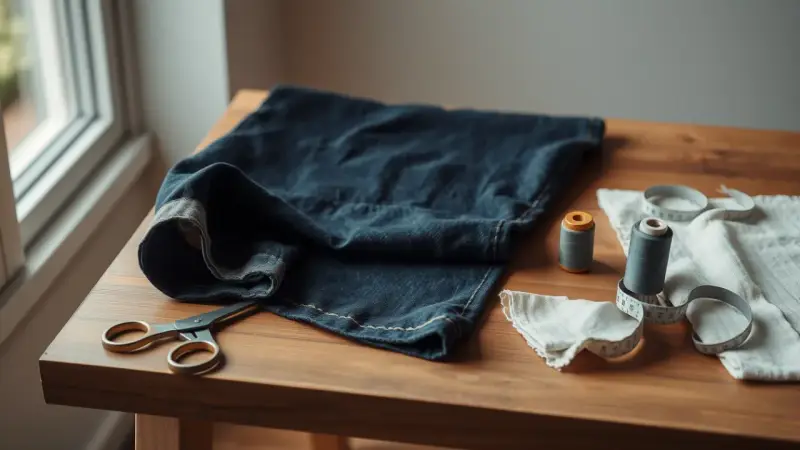
What You Need to Hem Jeans by Hand
- A sturdy hand-sewing needle. A sharp or embroidery needle works. Pick one strong enough to push through several layers of denim without bending.
- Strong thread. Use heavy-duty craft or upholstery thread, or regular all-purpose thread doubled. Match it to the denim. Gold or tan topstitching thread works if you want visible stitches that look like the factory seams.
- Marking tools. Tailor’s chalk or a fabric marker, a tape measure and a ruler.
- Straight pins or safety pins. Safety pins stay put better in thick denim.
- Sharp fabric scissors if you plan to cut, plus small snips for thread.
- Helpful extras. A thimble, an iron, and a hammer for flattening the bulky seams.
Which Way Should You Hem Your Jeans?
The best way to hem jeans by hand depends on how much length you’re removing and whether you care about the faded factory hem. Folding up the original hem works for most straight and bootcut jeans. Cutting gives a cleaner result on tapered legs or when a lot of length has to go.
| Method | Skill level | Time | Best for |
|---|---|---|---|
| Fold-up, keep original hem (no cutting) | Beginner | An evening | Straight or bootcut legs; keeping the worn factory look |
| Cut and sew a new double-fold hem | Beginner to intermediate | An afternoon | Large length changes; tapered or skinny legs |
| Cut off and reattach original hem | Intermediate | An afternoon | Tapered jeans where you still want the factory hem |
| Iron-on hem tape (no sewing) | Beginner | Quick | Temporary fixes; jeans you rarely wash |
How to Hem Jeans by Hand and Keep the Original Hem
The original-hem method shortens jeans by folding a tuck just above the factory hem and stitching it closed. The tuck counts twice: it takes out length on its front layer and on its back layer. So you fold up half the amount you want to remove.
Worked example: Your jeans are 2 inches too long. Fold the bottom up 1 inch, sew, and the leg ends up 2 inches shorter.
- Wash and dry the jeans first if they’re new or unwashed. Denim can shrink, and you want to hem the length you’ll actually wear.
- Try them on with the shoes you’ll wear most. Fold one leg under to the length you want and pin it. Ask a helper to pin it if you can, because bending over shifts the fabric.
- Measure the extra length. Take the jeans off. Measure from the bottom of the original hem to your pinned fold, then divide that number by two.
- Fold the tuck. With the jeans right side out, fold the hem up toward the outside of the leg by that half measurement. Pin all the way around, checking the depth every few inches so it stays even.
- Thread the needle. Cut about two arm’s lengths of thread, double it so you’re sewing with roughly one arm’s length, and knot the ends together.
- Stitch along the top of the original hem. Sew a backstitch right against the upper edge of the factory hem band, through every layer of the tuck. Keep the stitches small and even.
- Work through the side seams slowly. These are the thickest spots. Push with a thimble, or flatten the seam first with a few hammer taps on a hard surface.
- Lock the thread. Make a few tiny stitches on top of one another, knot tightly and trim.
- Turn the tuck inside. Fold the original hem down so the excess fabric sits inside the leg, then press with a hot iron. If the tuck is bulky, trim it to about ½ inch and whipstitch the raw edge so it doesn’t fray.
- Tack it down. Add a few stitches at each side seam to hold the folded excess flat against the inside. This keeps it from flipping down when you wear the jeans.
- Repeat on the second leg. Use the measurement from the first leg rather than pinning again, so both legs match.
How to Hem Jeans by Hand With a New Folded Hem
A new double-fold hem means cutting the leg and folding the raw edge under twice so no frayed edge shows. Use it when you’re taking off several inches. It also suits legs that taper, where a folded-up factory hem would come out wider than the leg above it.
- Mark the finished length with chalk all the way around the leg while the jeans are flat.
- Mark a cutting line below it. Allow the depth of your hem plus ½ inch for turning under. For a 1-inch-deep hem, cut 1½ inches below the finished line.
- Cut along the cutting line with sharp fabric scissors. Use the cut-off piece as a template for the second leg.
- Fold the raw edge under ½ inch and press it firmly with an iron.
- Fold again at the finished-length line, press, and pin. The raw edge is now hidden inside.
- Backstitch around the leg close to the inner folded edge. Sew from the outside if you want stitches that look like machine topstitching.
- Knot, trim and press the finished hem.
For tapered jeans where you still want the factory hem, cut the original hem off with a little fabric above it. Then cut the leg to the new length plus a small overlap, slip the old hem back on and backstitch it in place.
What Is the Best Stitch to Hem Jeans?
The backstitch is the best stitch for hemming jeans by hand. Each stitch doubles back into the one before it, which makes a solid, unbroken line that looks like a machine seam and survives repeated washing. Other stitches have narrower jobs:
- Backstitch. Strongest choice for the main hem line and for the original-hem tuck.
- Running stitch. Faster, simple in-and-out stitches. It’s weaker and can pull loose, so use small stitches or sew two rows.
- Blind stitch. Also called a slip stitch. It catches only a thread or two of the outer fabric, so almost nothing shows on the right side. It’s useful for tacking down the folded excess inside the original hem.
- Whipstitch. Loops over a raw edge to stop fraying on trimmed excess.
Running your thread over a block of beeswax before sewing helps keep doubled thread from tangling and knotting as you work.
Common Mistakes When Hemming Jeans by Hand
| Problem | Likely cause | Fix |
|---|---|---|
| Jeans came out too short | Folded the full amount instead of half (original-hem method), or marked while barefoot | Unpick the stitches, measure again in shoes, and fold half the excess |
| Legs are different lengths | Each leg was pinned separately | Measure the finished leg and copy that number to the other |
| Hem twists or puckers | Fold depth uneven or thread pulled too tight | Pin every few inches and check depth; tighten each stitch just until snug |
| Needle won’t pass through side seams | Too many denim layers | Hammer the seam flat, use a thimble, or sew one stitch at a time |
| Folded excess flips down inside the leg | Excess not tacked | Tack it to the side seams with a few blind stitches |
| Stitches pop on stretch jeans | Thread pulled too tight, so it can’t give when the denim stretches | Keep stitches slightly relaxed and use strong, doubled thread |
FAQ
– Is hemming tape better than sewing?
No. Sewing is more durable than iron-on hemming tape for jeans. Tape is quick and needs no needle, but heavy denim and frequent washing can loosen the bond over time. Use it for a temporary fix or to hold a fold in place before you sew it.
– What is the perfect length to hem jeans?
The right jeans length depends on the cut and the shoes you’ll wear. Straight and bootcut jeans usually look best just brushing the top of the shoe. Cropped and skinny styles can end at or above the ankle bone. Always mark the length while wearing your usual shoes and standing straight.
– How do you hem jeans by hand easily?
The easiest way to hem jeans by hand is the fold-up original-hem method, because it needs no cutting and gives you a factory look. Fold up half the length you want to remove, pin it evenly, and backstitch along the top of the original hem. If you don’t like the result, you can unpick it and try again.
– How do you shorten jeans without cutting or sewing?
You can shorten jeans without cutting or sewing by folding the hem to length and fusing it with iron-on hem tape. Press with a hot iron until the tape bonds. Cuffing the legs is another no-sew option that you can undo anytime.